30Jun
There is, quite frankly, an increasingly obvious truth about the American truck market: it has drifted so far from its utilitarian roots that a basic work truck, like what Slate is pitching America, now feels so radical that the entire country is agog.
The average new car transaction price in the US hit $48,644 in early 2026. A Tesla Cybertruck starts at $80,000. Even the Ford F-150 Lightning — before Ford pulled the plug on it — kicked off at $57,000.
Against that backdrop, two trucks (yes, it's not just Slate) have come to represent something genuinely different: the Slate, an American EV startup's stripped-down electric pickup set to begin deliveries in late 2026, and Toyota's IMV 0 (sold in production form as the Hilux Champ), a $10,000-to-$13,000 gasoline workhorse that Toyota sells across more than 180 countries but deliberately keeps out of the United States.
An attentive study of both vehicles, why they exist, and why one of them can't legally be sold here tells you a great deal about what the global auto industry actually values — and what it's been selling Americans instead.
The Slate: Radical Simplicity, American Edition
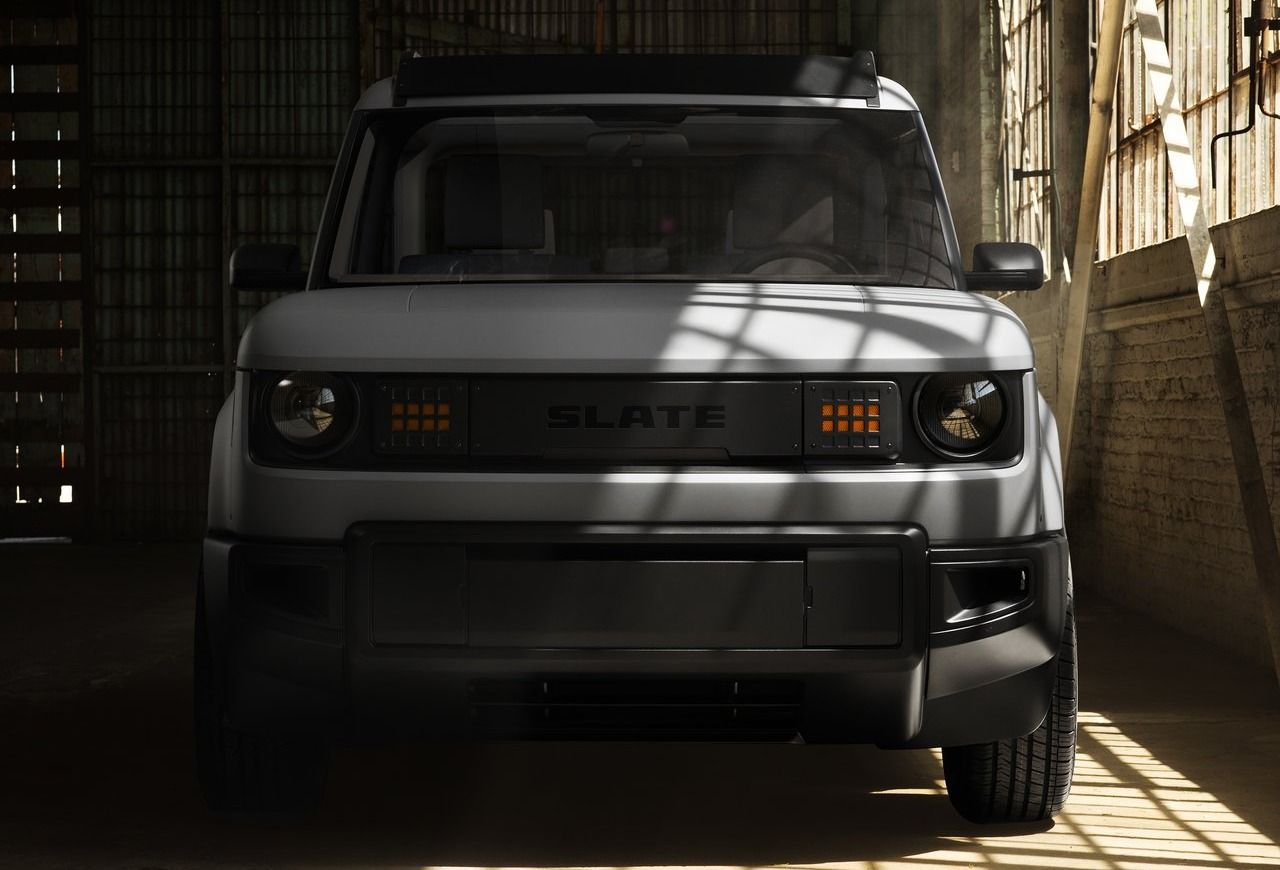
Image Credit: Slate.
The Slate truck starts at $24,950; so, it's virtually the cheapest EV in the US and, by a significant margin, the most affordable new truck of any kind. That money buys you something that feels almost confrontationally bare.
There's no touchscreen. No speakers. No power windows — you get a crank. The body panels are unpainted gray polypropylene composite, a talc-reinforced plastic that dents and bounces back rather than cracking when a shopping cart finds it. The implication of this design is a mixed bag.
Polypropylene shrug off dents and ensures everyday scrapes are less stressful (and they’re also corrosion‑proof, meaning no rust worries), but the unpainted gray look can feel utilitarian. That look is effectively the truck's most obvious feature, for better or worse.
And repairs may be trickier if a panel gets seriously damaged. Ultimately, it’s durable and low‑maintenance, even if style and resale value take a hit.
Every one of these trucks rolls off Slate's Warsaw, Indiana factory floor looking identical. If you want color, you buy a vinyl wrap; full-vehicle wraps start under $500, and the company offers over 100 options.
The engineering philosophy behind this is surprisingly rigorous. According to Slate's own engineers, every single component went through one question: does it need to be there?
Crank windows survived that question. NVH (noise, vibration, and harshness) insulation had to fight its way in.
Safety features were non-negotiable from the start.
The base configuration ships with traction control, electronic stability control, automatic emergency braking, pedestrian detection, forward collision warning, automatic high-beam assist, a rearview camera, and up to eight airbags. Slate says it's targeting a five-star NCAP crash rating.
Under all of that polypropylene is a 65-kilowatt-hour lithium iron phosphate battery (a chemistry apparently chosen for longevity and thermal stability rather than peak energy density) driving a single rear-mounted motor that produces 181 horsepower and 195 pound-feet of torque.
Estimated range is 205 miles. Towing capacity is 2,000 pounds; payload is 1,550 pounds. Those numbers are competitive with the Ford Maverick on payload, though the Slate is far from matching Maverick's 4,000 lbs max tow). At 174.6 inches long, the Slate is shorter than the Maverick, making it a more genuinely compact truck than the market has seen in decades.
DC fast charging via NACS (the former Tesla connector standard) gets you from 20% to 80% in about 30 minutes at 120 kW. The 10-year, 110,000-mile battery and powertrain warranty is one of the most aggressive in the industry for any vehicle at this price.
The suspension is deliberately old-school: MacPherson struts up front, a de Dion (non-independent) axle with coil springs out back. Both choices contributed a great deal to the Slate's under-$25k price tag, while maintaining ride predictability.
De Dion axles are a particularly smart choice here because, while simpler than independent rear suspension, they don't suffer the unsprung weight penalty of a traditional solid axle.
The modular philosophy extends to the truck's body itself.
The base configuration is a two-seat pickup, but customers can purchase a kit to convert it to a five-seat SUV in either a squared-off "Squareback" or sloped "Fastback" roofline. This option can be done after purchase.
With over 175 accessories available at launch, the Slate is essentially a platform for personalization at a price that historically has not offered any personalization at all.
The Toyota IMV 0: The Dirt-Cheap Work Truck America Can't Have
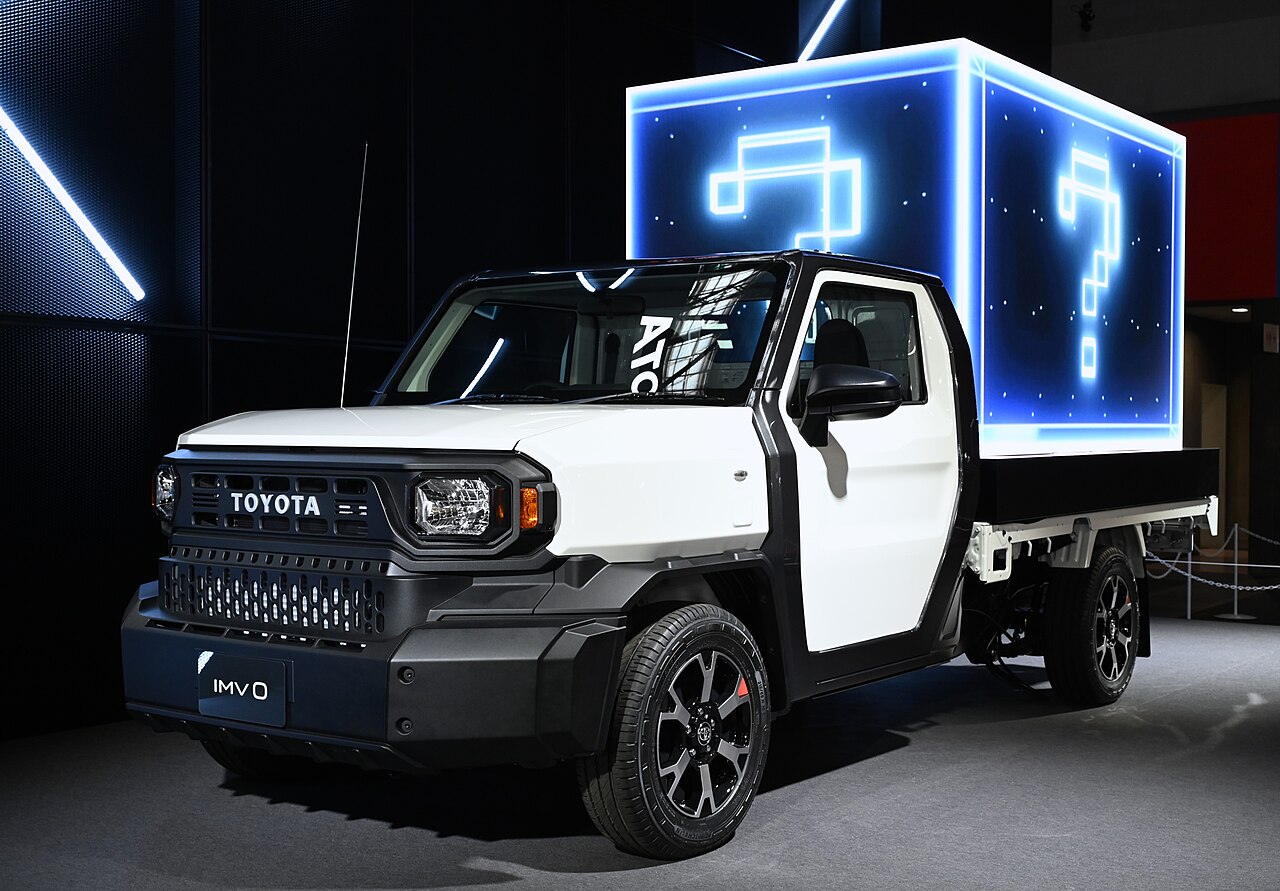
Image Credit: TTTNIS - Own work, CC0, Wikimedia.
Toyota unveiled the IMV 0 concept in December 2022 at Toyota Motor Thailand's 60th anniversary event, riding on the same Innovative International Multi-Purpose Vehicle (IMV) platform as the legendary Hilux. It launched in production form as the Hilux Champ in 2023, initially priced at around $10,000 (459,000 Thai baht), though the production version settled closer to $13,000 by launch.
That ten to thirteen grand buys a 2.0-liter inline-four gasoline engine producing 137 horsepower, mated to a 5-speed manual transmission, with a curb weight of approximately 3,248 pounds.
Optional powertrains include a 2.7-liter gasoline four-cylinder or a 2.4-liter turbodiesel, a powertrain choice that reflects the truck's intended customers, many of whom put enormous mileage on commercial work vehicles and know that diesel torque and fuel economy matter more than headline horsepower.
The ultra-sparse interior includes three HVAC knobs; no infotainment screen, no radio. Toyota's guiding philosophy for the IMV 0 is something they explicitly called "deliberate incompleteness." The truck is intentionally delivered roughly 70% finished.
The remaining 30% is left to owners and small businesses to customize for their exact use cases, whether that's a delivery van, a mobile shop, a farm truck, or an overlanding build.
The bed, roof, and back of the cab come pre-drilled for accessories. Front fenders are bolt-on for easy replacement. The three-piece plastic bumper design makes individual section swaps simple and cheap. Toyota even presented a disaster-relief variant with Red Cross branding at its concept reveal, nodding to the truck's potential humanitarian applications.
Reviewers who've driven the IMV describe an experience that is disarmingly confidence inspiring. One writer at Motor1 noted how the truck's thin A and B pillars gave excellent visibility, and how its manageable dimensions made tight maneuvering genuinely easy. Sounds like a stark contrast to modern full-size trucks that require 360-degree camera arrays to park safely.
The IMV 0 turns on a 16.1-foot radius, tighter than other Hilux variants, courtesy of a modified steering rack optimized for dense, urban Southeast Asian traffic patterns. Payload capacity exceeds 2,000 pounds.
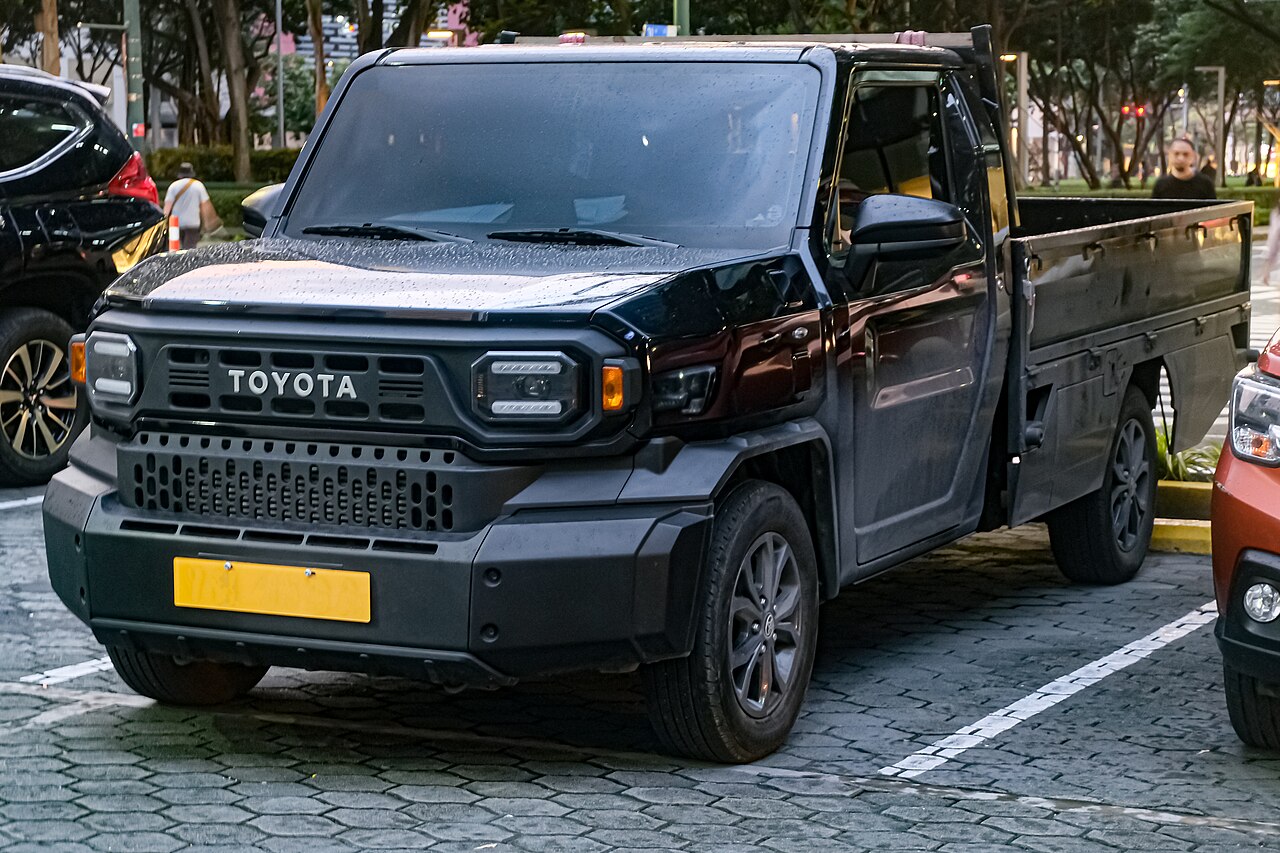
Image Credit: Ethan Llamas - Own work, CC BY-SA 4.0, Wikimedia.
So why can't Americans have one? The barriers are structural, layered, and, frankly, somewhat absurd. You know it.
The Chicken Tax is the first problem. This is a 25% tariff on imported light trucks that has been in place since 1963, originally imposed as retaliatory trade policy against European tariffs on American frozen chicken. It remains one of the most consequential pieces of trade policy in automotive history, having essentially foreclosed the possibility of affordable imported pickup trucks in the American market for six decades.
An IMV 0 imported from Thailand would arrive with a 25% tariff applied before it reached a dealership lot. That alone would erode the price advantage substantially.
Then there's regulatory compliance.
The US has some of the most demanding auto safety and emissions standards in the world. The IMV 0 ships with just two airbags — nowhere near what federal motor vehicle safety standards require. It lacks the suite of advanced driver assistance systems (ADAS) that, while not federally mandated, have become table stakes for NHTSA favorable safety ratings.
Complying with US emissions regulations would require meaningful changes to the engine package. Each of these upgrades adds cost and engineering time. Toyota's chief engineer for the IMV platform acknowledged that the truck was designed at "70% finished," which implicitly means the missing 30% are features American regulatory frameworks treat as baseline requirements.
And even if Toyota cleared all of those hurdles, there's a cannibalization problem. A US-compliant, tariff-adjusted IMV 0 would never sell at the same $10k price as in Thailand. It'd probably cost the same as the Tacoma or at least encroach its price territory. Toyota would then be competing with itself in a market where Tacoma margins are significantly higher.
A Tale of Two Trucks, Compared Honestly
Image Credit: Ethan Llamas - Own work, CC BY-SA 4.0, Wikimedia / Slate.
These two vehicles make for a compelling comparison, precisely because they share a philosophy while arriving from completely different engineering traditions.
Both reject the prevailing American assumption that trucks must be loaded with screens, luxury stitching, and features nobody asked for. Both treat modularity as a core design principle rather than an afterthought. Both are deliberately incomplete at the base level, inviting customization. And both land at a price point that may have seemed unremarkable in 2005 but now qualifies as disruptive.
Where they diverge is in almost every technical dimension.
The Slate is electric, the IMV 0 is combustion. The Slate has 181 hp; the IMV 0's base engine produces 137 hp. The Slate's estimated range is 205 miles; the IMV 0's diesel variant can stretch considerably farther on a tank, and refueling takes three minutes rather than 30.
The Slate ships with eight airbags and an aggressive ADAS safety package; the IMV 0 ships with two airbags and no driver assistance systems. The Slate has never been crashed by NHTSA or IIHS; the IMV 0 doesn't even bother with those tests for its target markets.
The real-world use cases are actually quite different too.
The Slate is a compelling urban and suburban commuter truck — 205 miles of range covers the vast majority of American daily driving patterns, the compact dimensions suit parking in dense environments, and the EV running costs (particularly on residential charging) undercut gasoline dramatically over time.
A delivery business running short urban loops, a contractor hauling modest loads to job sites, a small farmer doing daily farm errands; these are the Slate's people.
The IMV 0, built on the battle-tested Hilux platform, is a different animal. It's designed for roads that don't appear on Google Maps, for business owners in emerging economies who need a vehicle that a local mechanic can fix with parts sourced from a single hardware store shelf.
The irony is that many in America will gladly pay top dollar for a truck built with the robustness to handle roads that aren't on Google Maps and they can fix themselves without been locked out by manufacturer software.
Its diesel variant offers fuel economy in the low-to-mid 30s (mpg equivalent), and diesel infrastructure in Southeast Asia and Latin America is dense enough that range anxiety is irrelevant. For those markets, the IMV 0 isn't just affordable; it's strategically correct.
The Slate's long-term cost of ownership looks attractive in a market with robust EV infrastructure, but charging dead zones, range anxiety on longer hauls, and even the complete absence of federal tax credits (eliminated under the One Big Beautiful Bill Act in September 2025) complicate the calculus.
The IMV 0's raw mechanical simplicity means lower maintenance costs and more accessible repairs. It's a genuine advantage in any market, including the US, where the average consumer now holds onto their cars longer than ever.
What These Trucks Tell Us
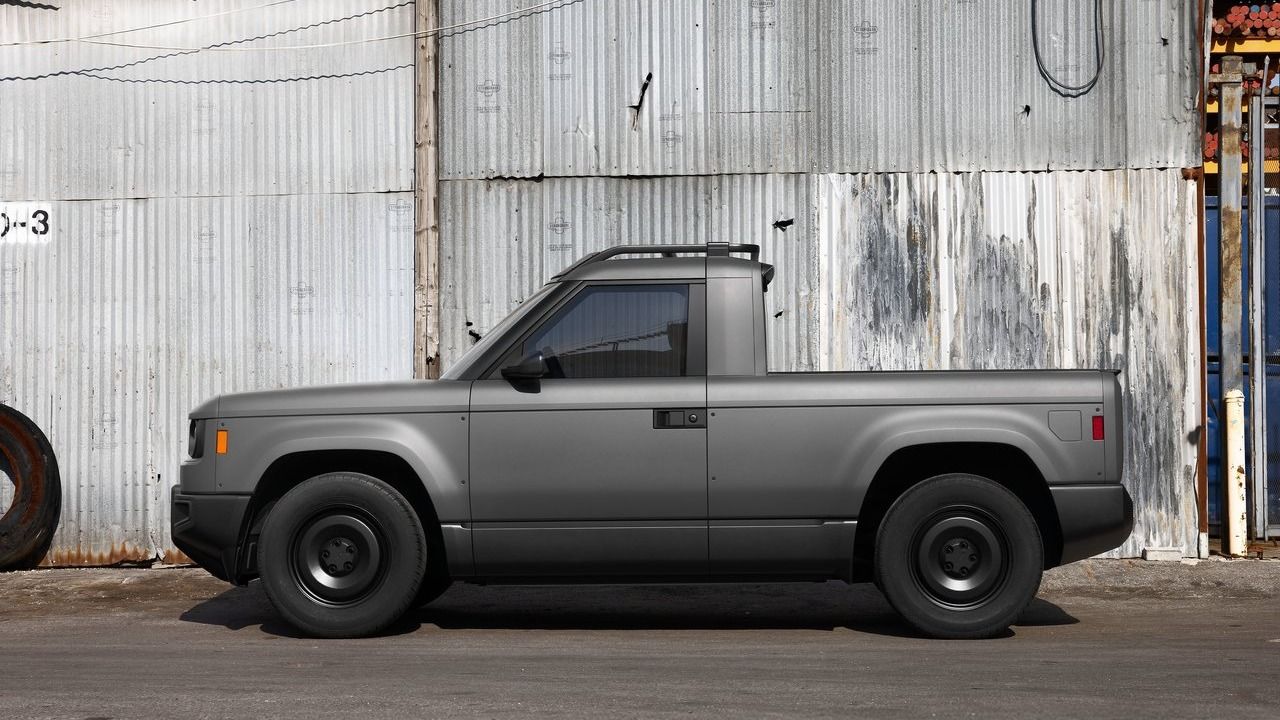
Image Credit: Slate.
The fact that Americans are buzzing about a $25,000 stripped-down American EV startup truck while a proven $13,000 Toyota truck exists and thrives globally reveals something uncomfortable about how US auto regulation, trade policy, and market structure interact.
The IMV 0 can't come here not because it's a bad truck ( by most accounts it's an excellent one) but because the system isn't built to accommodate it. Tariffs protect domestic manufacturers. Safety mandates, however well-intentioned, raise the floor on what a car costs to certify. And automakers rationally avoid products that cannibalize their own higher-margin lineup.
The Slate is, in a sense, the American answer to a question that Toyota already solved for the rest of the world. It's more expensive, more technologically complex, and carries the inherent execution risk of a brand-new startup with 100,000 reservations and no delivery track record. But it's what the market can actually produce and sell inside the United States in 2026, given the constraints in place.
Both trucks say the same thing to the industry: people want fewer features and a lower price, not more of both. The disagreement is about how to get there — and which side of a regulatory border you happen to be standing on. Ultimately, the Slate will finally test the long-held theory that America is hungry for cheaper cars with fewer tech.
Slate truck Toyota Hilux Champ IMV 0 affordable electric truck cheap pickup trucks US auto market Chicken Tax automotive regulations bare-bones vehicles EV startup Toyota Tacoma truck pricing American car buyers vehicle customization auto industry trends Slate EV Warsaw Indiana no-frills truck crank windows electric work truck
Comments