16Jun
image Credit: Armi e Tiro.
Beretta Defense Technologies is preparing to unveil a new counter-drone system that looks unlike anything typically associated with traditional firearms manufacturers: an automated, eight-barrel remote weapon station designed specifically to shoot down hostile drones.
According to a report by Defence Blog, the Italian defense company will officially present the system, known as the LIVET Remote Controlled Weapon Station (RCWS), at Eurosatory 2026, one of the world's premier defense exhibitions scheduled to take place in Paris from June 15 to 19.
The unveiling signals how rapidly the global defense industry is adapting to the drone age, where inexpensive unmanned aerial vehicles have evolved from niche reconnaissance tools into some of the most disruptive weapons on modern battlefields.
An Eight-Barrel Solution to a Growing Threat
At the heart of the LIVET system are eight Benelli Drone Guardian shotgun systems mounted on a single automated turret.
Unlike conventional machine guns or rifles, the Drone Guardian was designed from the ground up to counter small drones. It employs semi-automatic shotgun technology paired with programmable air-burst ammunition capable of detonating at calculated distances.
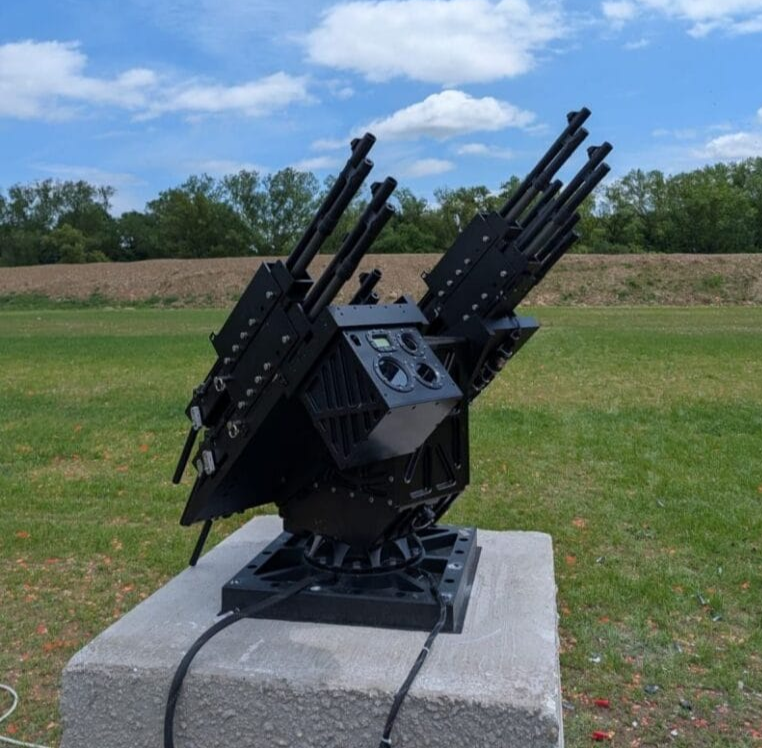
Image Credit: Ares Difesa.
The idea is simple: small drones are notoriously difficult targets. Their compact size, unpredictable flight paths, and high maneuverability make scoring direct hits with single-projectile weapons challenging, even for trained operators.
Shotgun-based solutions offer a different approach. Instead of relying on pinpoint accuracy, they project multiple pellets toward the target area, increasing the likelihood of disabling or destroying a drone. When combined with programmable ammunition that bursts near the target, the probability of a successful interception rises significantly.
LIVET essentially scales that concept upward. By integrating eight Drone Guardian systems into a remotely operated platform, Beretta has transformed what was previously an individual weapon into a dedicated defensive installation capable of protecting larger assets and responding to multiple aerial threats.
Automated Tracking Reduces Human Burden
One of the system's defining features is its auto-tracking capability.
In traditional engagements, operators must manually track a drone through optical systems while simultaneously aiming and firing. That process demands exceptional hand-eye coordination and situational awareness, particularly when confronting fast-moving targets under stressful conditions.
LIVET seeks to remove much of that burden.
Using a combination of sensors and targeting software, the turret automatically maintains a firing solution on detected drones. Operators are therefore responsible for authorizing engagement decisions rather than physically steering the weapon toward the target.
According to Defence Blog, Beretta developed the platform in collaboration with Italian technology company DUALEE, although the companies have not disclosed the exact nature of DUALEE's technological contribution.
Nevertheless, the integration appears intended to shorten the interval between threat detection and engagement, enabling faster reactions against drones approaching protected areas.
Lessons From Ukraine
The emergence of systems like LIVET reflects the profound impact recent conflicts have had on military thinking.

Getty Images.
Since Russia's full-scale invasion of Ukraine in 2022, small drones have demonstrated an extraordinary ability to reshape warfare. Cheap commercial quadcopters have been modified to drop explosives, while first-person-view (FPV) attack drones costing only hundreds of dollars have destroyed armored vehicles worth millions.
Military planners worldwide have been forced to acknowledge that traditional air-defense systems are often ill-suited to addressing these threats. The result has been a surge in demand for dedicated counter-drone technologies.
Electronic warfare systems that jam communications, directed-energy weapons such as high-powered lasers, and kinetic interceptors designed to physically destroy targets have all attracted investment. LIVET firmly occupies the kinetic category.
Its purpose is not to confuse, redirect, or disable drone communications. Instead, it is designed to ensure hostile drones are destroyed before reaching their intended targets.
Why Eight Barrel?
The choice to equip the turret with eight separate weapon systems offers practical advantages beyond visual impact.
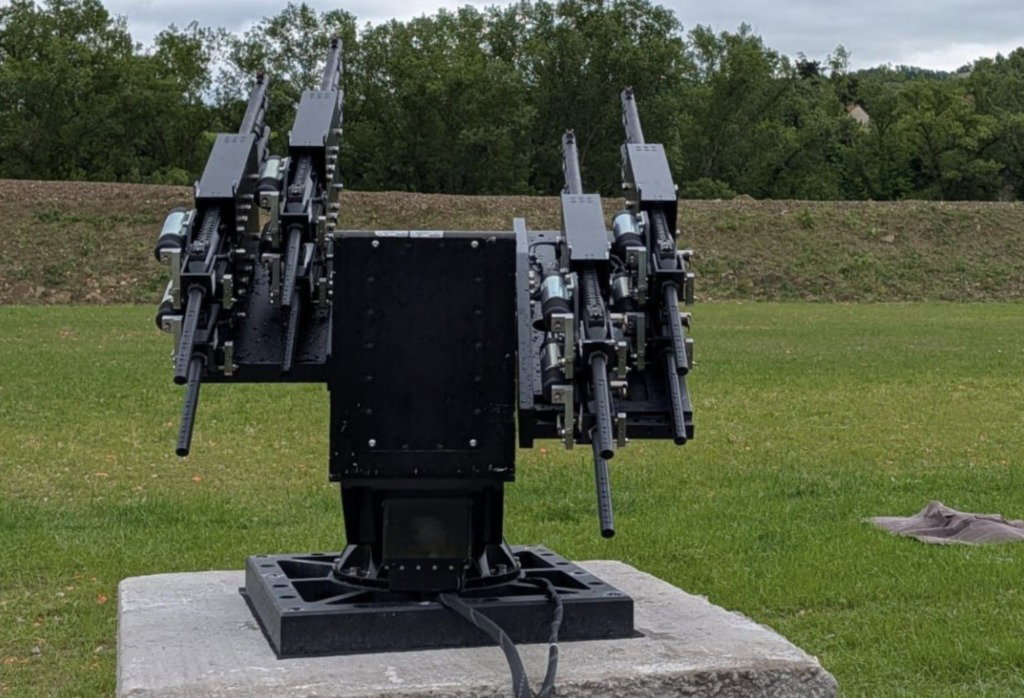
Image Credit: NextGen Defense.
Redundancy is one benefit. If one shotgun suffers a malfunction or exhausts its ammunition supply during an engagement, the remaining weapons continue operating. The configuration also increases engagement capacity.
Modern drone attacks increasingly involve swarming tactics, in which multiple aircraft approach simultaneously to overwhelm defenses. A single-barrel solution may struggle against such scenarios, whereas an eight-barrel platform could engage multiple threats in rapid succession.
Beretta says the system's modular design allows it to be adapted for different operational environments. Potential applications include fixed installations protecting critical infrastructure, mobile deployments mounted on vehicles, and standalone defensive positions securing military facilities.
A Historic Gunmaker Enters the Drone Era
LIVET also represents an evolution for Beretta itself.
Founded in 1526 in Italy's Val Trompia region, the Beretta Group is widely regarded as the world's oldest continuously operating firearms manufacturer. While best known to civilian consumers for sporting shotguns and handguns, its defense division has increasingly expanded into advanced military technologies.
Benelli, the manufacturer behind the Drone Guardian platform, is also part of the Beretta Group. That means LIVET is the product of technologies developed within the same industrial family rather than through an outside acquisition.
Its debut at Eurosatory places it directly before defense ministers, procurement officials, and military delegations searching for effective responses to one of today's fastest-evolving threats.
As the proliferation of inexpensive drones continues to challenge conventional defenses, systems like LIVET underscore a broader reality: the future of air defense may not always rely on missiles and radar.
Sometimes, it may involve centuries-old shotgun expertise reimagined through automation, software, and modern battlefield necessity.
Source: Defence Blog
Beretta counter-drone system LIVET RCWS remote weapon station anti-drone technology Benelli Drone Guardian Eurosatory 2026 automated turret drone swarms air defense kinetic interceptors shotgun anti-drone Ukraine drone warfare defense technology Beretta Defense Technologies DUALEE programmable air-burst ammunition C-UAS counter-UAS military innovation Paris defense exhibition
Comments