28May
Russia has unveiled a new counter-drone weapon system that pushes air defense technology deeper into the era of programmable munitions.
The development reflects a growing emphasis on protecting ground assets from small unmanned aerial threats. The system is designed specifically to engage quadcopters and fixed-wing drones that have become common on modern battlefields.
The new turret, known as the ZAK-30 Citadel, was presented by Russia’s state-owned defense conglomerate Rostec. It fires 30mm programmable airburst rounds designed to detonate at precise points along a drone’s flight path. Instead of relying on direct hits, the system creates expanding clouds of fragmentation in the air.
According to its developers, the Citadel integrates radar and optical tracking systems that continuously monitor incoming aerial targets.
These sensors feed targeting data into a fire control system that calculates the optimal detonation timing for each round. The goal is to maximize interception probability while reducing ammunition expenditure.
Officials say the system has already been tested in combat conditions and is intended for continuous, around-the-clock operation. It is expected to be demonstrated at a security forum in Moscow, signaling both operational confidence and an export-oriented showcase strategy.
ZAK-30 Citadel System Overview
The ZAK-30 Citadel is a stationary anti-drone turret designed to defend fixed installations from aerial intrusion. Its architecture centers on a swiveling gun mount that can elevate and rotate to track fast-moving targets across a wide arc of the sky.
Visually, the system resembles a compact air defense cannon mounted on a reinforced platform. The turret head is engineered for high-angle engagement, allowing it to target drones that approach from elevated or irregular trajectories.
The system is intended to operate in autonomous or semi-autonomous modes, reducing the need for constant human control. Operators can oversee multiple units remotely, which allows a wider defensive perimeter to be maintained without increasing personnel requirements.
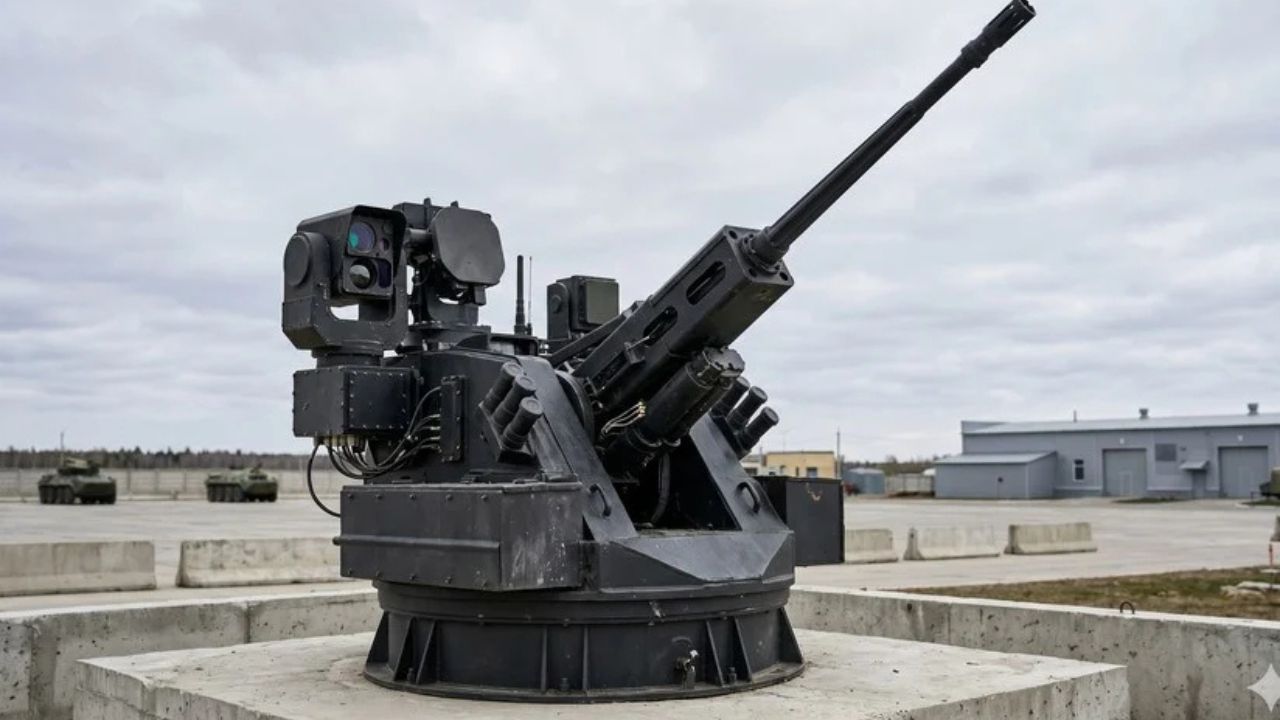
Photo Credit: HDBlog.
Rostec describes the Citadel as a response to the increasing tactical use of low-cost drones in reconnaissance and strike roles. By focusing on automation and programmable ammunition, the system aims to close gaps exposed by traditional short-range air defenses.
Programmable 30mm Airburst Ammunition
At the core of the Citadel system is its use of programmable 30mm airburst shells. These rounds are fitted with remote-controlled fuzes that can be set to detonate mid-flight at calculated distances from the target.
When fired, each shell receives timing instructions based on tracking data from the radar and optical sensors. The system then adjusts detonation timing in real time to match the drone’s movement and speed.
Instead of striking a drone directly, the round bursts into a cloud of high-velocity fragments designed to intersect its flight path. This approach increases the effective hit radius and compensates for the difficulty of precision targeting against small aerial objects.
Officials claim that significantly fewer rounds are required to neutralize a single drone compared to conventional ammunition. This efficiency is particularly important in sustained engagements where drone swarms or repeated incursions could otherwise deplete ammunition stocks rapidly.
Similar technologies have already been deployed in Western systems, including those developed by Rheinmetall. The company’s Skyranger turret family uses AHEAD airburst rounds that release tungsten sub-projectiles to form a dense interception pattern.
Sensor Tracking and Fire Control Integration
The Citadel’s effectiveness depends heavily on its integrated sensor suite, which combines radar detection with optical tracking. This dual-layer approach is intended to maintain target visibility even under complex environmental conditions.
Radar systems provide early detection of incoming drones, identifying speed, direction, and altitude. Optical sensors then refine tracking data, allowing the fire control system to maintain a precise lock on small and agile targets.
Once a target is confirmed, the system’s fire control computer calculates projectile trajectory and detonation timing. These calculations are continuously updated as the drone changes speed or direction.
The combination of sensing and automated firing decisions reduces the reaction time required to engage fast-moving aerial threats. It also allows the system to operate under degraded visibility conditions, such as nighttime or adverse weather.
This level of automation reflects broader trends in modern air defense, where human operators increasingly supervise rather than directly control engagement sequences.
Global Context and Counter-Drone Arms Race
The introduction of the Citadel fits into a wider global push to counter the proliferation of small drones in military operations. Many armed forces now treat low-cost aerial systems as persistent battlefield hazards rather than niche tools.
Western manufacturers have developed comparable technologies, including systems built by Northrop Grumman. Its Bushmaster chain gun platforms can fire Mk310 programmable airburst munitions, which operate on similar fragmentation-based interception principles.
These systems reflect a shared solution to the same problem: drones are small, cheap, and difficult to hit directly. Airburst ammunition creates a probabilistic kill zone rather than relying on pinpoint accuracy.
The rise of programmable ammunition also signals a shift in how air defense is conceptualized. Instead of single-shot interception, systems are increasingly designed for layered, sensor-driven saturation of a target area.
Russia’s unveiling of the Citadel suggests continued competition in this niche of military technology. As drone usage expands across reconnaissance and strike roles, both defensive and offensive systems are evolving in parallel, each pushing the other toward greater automation and precision.
Sources: Business Insider
ZAK-30 Citadel Rostec Russia counter-drone anti-drone system programmable ammunition 30mm airburst air defense drone defense C-UAS counter-UAS unmanned aerial vehicles quadcopter defense military technology defense news Russia military drone swarm fragmentation munitions AHEAD ammunition fire control system radar tracking optical tracking autonomous defense fixed installation defense Skyranger Rheinmetall Northrop Grumman Bushmaster Mk310 programmable fuze anti-drone turret battlefields drones low-cost drone threat Moscow security forum ground-based air defense short-range air defense SHORAD emerging military tech.
Comments